
.png)
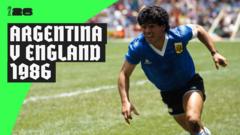
Diego Maradona did not just beat England in Mexico City on 22 June 1986 — he redefined what one player could do to an international football match. Argentina's quarter-final victory at the Azteca Stadium remains one of the most analysed and debated ninety minutes in World Cup history, and Maradona was the reason for all of it.
He scored twice. The first, punched in with his left hand and immediately claimed as a goal, became known as the Hand of God — a moment of audacious deception that fooled the referee and has never stopped generating argument. The second, four minutes later, was the opposite in every way. Maradona collected the ball inside his own half, beat five England outfield players and goalkeeper Peter Shilton, and finished with his left foot. It has since been voted the Goal of the Century.
Argentina won 2-1, with Gary Lineker pulling one back late, but England were powerless to contain Maradona across the ninety minutes. He was the fulcrum of everything Argentina did going forward, dropping deep to collect possession, accelerating past challenges that should have stopped him, and operating on a level that his opponents simply could not match.
The context mattered too. The 1982 Falklands War had loaded this fixture with political weight that neither squad could fully ignore. Maradona himself acknowledged the significance of the occasion, and his performance carried the force of something beyond club football or even ordinary international competition.